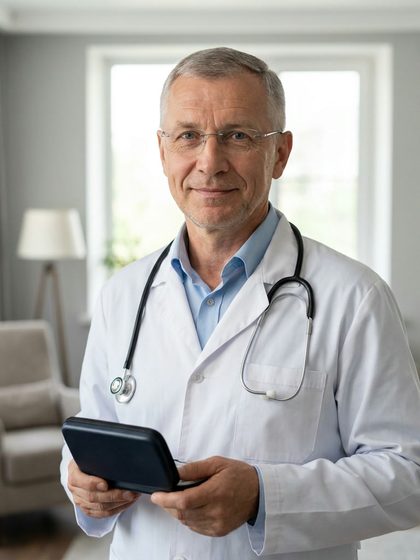
Reviewed bySergey Vorontsov, MDCardiologist, house calls, Makes house calls · updated 8 Nov 2026
Key facts
- Who comes
- A cardiologist; when indicated, a nurse to fit a Holter monitor or ABPM
- What they bring
- Portable ECG, blood pressure monitor, pulse oximeter, stethoscope, and Holter and ABPM equipment
- How long it takes
- About 45–60 minutes, a little longer if a 24-hour monitor is fitted
- Arrival time
- Around the clock, on average within 60 minutes in the city; scheduled visits at a convenient time
- When to call 103 urgently
- Chest pain lasting more than a few minutes, sudden shortness of breath, fainting, signs of a stroke, a very fast or very slow pulse with weakness
- Documents
- ID card, previous ECGs, discharge summaries, echocardiogram and lab results, and a blood pressure diary
What you should know
Heart and blood vessel diseases are among the most common reasons older people need regular monitoring. Yet they are often the ones who find it hardest to get to a clinic: breathlessness on the stairs, swollen legs, weakness. Calling a cardiologist to your home in Pavlodar lets you see a specialist without leaving your apartment. The doctor arrives with an ECG machine and can start 24-hour ECG or blood pressure monitoring right at home, without putting tests off for weeks.
The cardiologist explains things the way a family doctor would: what the numbers on the blood pressure monitor mean, why each medication is needed, how to keep a blood pressure diary and which signs require immediate help. The DomVrach specialist does not rush and answers the whole family's questions. We are honest about the limits of a home visit. Crushing or burning chest pain lasting more than a few minutes, sudden shortness of breath, fainting, or weakness on one side of the body is a reason to call 103 or 112 straight away, not to wait for a cardiologist.
When to call a cardiologist to your home
- blood pressure is often above your usual readings despite ongoing treatment
- a feeling of skipped beats, a racing heart or the heart "stopping" for a moment
- shortness of breath with normal activity and swollen legs by evening
- treatment needs to be chosen or reviewed after discharge from a cardiology ward
- an elderly person finds it hard to get to a scheduled cardiology appointment
- 24-hour ECG or blood pressure monitoring at home is needed
- dizziness and weakness while taking blood pressure medications
If several points apply, call a doctor. For chest pain, difficulty breathing, signs of stroke, seizures or loss of consciousness, call 103 or 112 immediately.
What most often leads to heart problems
The most common cause is high blood pressure (arterial hypertension). Persistently raised blood pressure gradually puts strain on the heart, blood vessels, kidneys and brain, while the person may feel no symptoms for a long time. The group also includes coronary heart disease, rhythm disturbances, in particular atrial fibrillation, and chronic heart failure, which causes shortness of breath and swelling.
The risk of these diseases is increased by smoking, excess weight, physical inactivity, diabetes, high cholesterol, too much salt and chronic stress. Many of these factors can be changed, and this is especially important for people in Pavlodar with high blood pressure. According to WHO recommendations and the clinical protocols of the Ministry of Health of the Republic of Kazakhstan, it is controlling blood pressure and lifestyle, together with taking the prescribed medications consistently, that lowers the risk of heart attack and stroke.
What happens during a cardiologist home visit
The cardiologist asks about your symptoms, family history, lifestyle and current medications, and reviews previous discharge summaries and ECGs. Then they measure blood pressure on both arms, listen to the heart and lungs, check the legs for swelling and record an ECG. If necessary, they fit a Holter monitor or ABPM. At the end, you receive a written plan. Monitoring results and blood pressure trends can later be conveniently discussed during an online consultation.
Coronary angiography, stress tests and a full expert-level echocardiogram cannot be done at home, so if needed the cardiologist will refer you to a clinic for tests. A portable ultrasound is possible when indicated. If a heart attack, acute heart failure or a dangerous arrhythmia is suspected, the doctor calls 103 and helps until the crew arrives.
How we help
ECG at home
An electrocardiogram is recorded in a few minutes with a portable machine and interpreted by the doctor immediately. It shows the heart rhythm and rate, and signs of a past or acute disruption of the heart's blood supply. Comparing it with previous ECGs is especially valuable, so keep all the tracings and reports in one folder and show them to the doctor.
Holter and ABPM
Holter monitoring records the ECG over 24 hours, while ABPM measures blood pressure at regular intervals, including at night. This helps catch occasional irregular beats and shows how the medications are working. The device is fitted and removed at home, and the patient keeps a diary: when they walked, slept and took their tablets, and how they felt.
Choosing and adjusting treatment
Treatment for hypertension, arrhythmias and heart failure is tailored individually according to clinical guidelines. The cardiologist takes into account age, kidney function, other conditions and medications. Changing or stopping medications on your own is dangerous: abruptly stopping some groups of drugs can make your condition worse. The doctor explains and writes down every change.
Education and prevention
The cardiologist teaches you how to measure blood pressure correctly, keep a diary and recognize the signs of decompensation: rapid weight gain, increasing swelling and shortness of breath when lying down. They discuss eating less salt, manageable physical activity and quitting smoking. Following WHO recommendations, these simple measures make a noticeable difference alongside medication.
Myths and facts
MythIf your blood pressure is back to normal, you can stop the tablets
FactNormal blood pressure during treatment is the result of the medications working, not a sign that the disease has gone. Once they are stopped, it usually rises again. The regimen should be changed only together with your doctor.
MythChest pain always means the heart, and no pain means a healthy heart
FactChest pain can also be caused by problems with the spine, stomach or lungs, while heart disease sometimes causes no pain and shows up as shortness of breath or weakness. That is why an examination and an ECG matter, and with severe pain, call 103 straight away.
MythA cardiologist can do nothing at home without a big clinic
FactAt home, a cardiologist carries out a full examination, records an ECG, fits a Holter monitor or ABPM and adjusts treatment. Complex tests are arranged at a clinic if needed, but many issues are resolved during a home visit.
How to call a doctor
- Call or message usWe answer 24/7: we'll ask about symptoms, age and chronic conditions and tell you which doctor you need. If an ambulance is needed, we'll say so straight away.
- Give us the addressHome, apartment, hotel or office. We'll tell you when the doctor will arrive — in the city, about 60 minutes on average.
- The doctor arrivesExamination, blood pressure, oxygen saturation, temperature and, if needed, an ECG, rapid tests and blood draw. The doctor explains the diagnosis and prescribes treatment.
- You get helpAn injection or IV drip if indicated, written advice, a sick note or certificate after the examination, and a follow-up call.
Prices in Pavlodar
| Specialist home visit | 22 500 ₸ |
| ECG with interpretation during the visit | 5 500 ₸ |
| Follow-up visit | 13 500 ₸ |
| Phone advice | free |
The final cost is agreed before treatment starts. Prices are in tenge and do not constitute a public offer.
Where to get help
In pavlodar you can get help at home, at one of our two addresses (116 Mira St., office 10, Pavlodar, 58 Tolstogo St., office 10, Pavlodar) or online if you need advice rather than an examination. We answer 24/7 and will suggest the best option.
Confidential and private
in Pavlodar the doctor comes at a convenient time, including to your hotel or office. Treatment documents are given only to the patient or their legal representative.
Questions and answers
How is a cardiologist visit different from a GP visit?
A GP assesses your health as a whole, while a cardiologist goes deeper into diseases of the heart and blood vessels specifically: they choose complex treatment, assess arrhythmias and heart failure, and interpret Holter and ABPM results. If you are not sure which doctor you need, start with a GP, who will advise you.
What should I prepare before the cardiologist arrives?
Gather all previous ECGs, discharge summaries, echocardiogram and lab results in one folder. Put all the medications you take next to them and write down exactly how you take them. If you have kept a blood pressure diary, show it to the doctor. Do not drink strong coffee or smoke for an hour before the visit.
Can a Holter monitor be fitted at home?
Yes, Holter monitors and ABPM devices are fitted at home. The monitor is usually worn for 24 hours while you keep a diary of your activity and how you feel; then it is removed and the data are analyzed. The cardiologist discusses the results with you at a follow-up visit or during an online consultation.
When should I not wait for a cardiologist?
If crushing or burning chest pain lasts more than a few minutes, or sudden shortness of breath, cold sweats, fainting, a drooping face or arm weakness appears, call 103 or 112 immediately. Until the ambulance arrives, help the person sit up, loosen tight clothing and do not leave them alone.
How often should I see a cardiologist?
It depends on the condition and how stable it is. While treatment is being adjusted, visits are needed more often; when the condition is stable, less often, on a schedule set by the doctor. Many patients in Pavlodar combine home visits with online consultations so they can discuss their blood pressure diary between examinations.
Can a cardiologist do a heart ultrasound at home?
A portable ultrasound is possible when indicated and helps with an initial assessment. However, a full echocardiogram with detailed measurements is performed on a stationary machine at a clinic. The cardiologist will tell you whether the home scan is enough or a full examination is needed.
Where do doctors visit in Pavlodar and where are the branches?
Home visits cover all city districts and nearby settlements, 24/7. Appointments at two branches: 116 Mira St., office 10, Pavlodar and 58 Tolstogo St., office 10, Pavlodar. Phone in Pavlodar: +7 (700) 309-38-25.
Sources and methodology
This page was prepared by the DomVrach medical editorial team based on:
- Clinical diagnosis and treatment protocols of the Ministry of Health of the Republic of Kazakhstan
- Code of the Republic of Kazakhstan “On Public Health and the Healthcare System”
- International Classification of Diseases ICD-10, World Health Organization
- WHO recommendations on primary health care
- NICE (UK) guidelines on managing acute and chronic conditions in primary care
This information is for reference only and does not replace a consultation with a specialist. Editorial policy