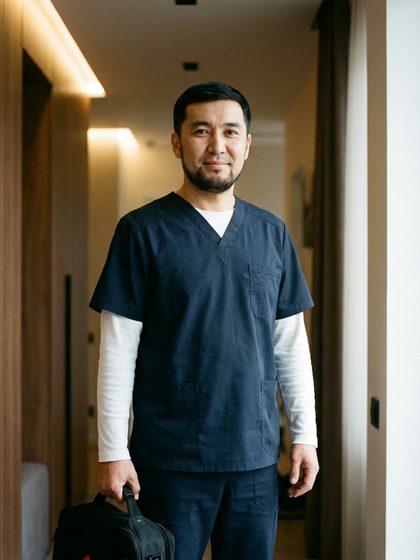
Reviewed bySerik Nurgaliev, MDAddiction physician, house calls, Makes house calls · updated 8 Nov 2026
Key facts
- Who comes
- A treatment-room nurse; if there is no prescription or there are doubts, a doctor comes first for an examination
- What they bring
- Single-use syringes and needles, antiseptics, sterile wipes, adhesive plasters, a blood pressure monitor, an emergency kit for allergic reactions
- How long it takes
- The injection itself takes a few minutes; the visit, including checking the prescription and observation, takes 15–30 minutes
- When the nurse arrives
- About 60 minutes on average for an urgent call; for a course of injections, at the same convenient time every day
- When to call 103 immediately
- Swelling of the face and throat, difficulty breathing, sudden weakness and a drop in blood pressure, seizures, loss of consciousness after an injection
- Documents
- ID, the doctor’s prescription stating the medicine and route of administration, information about allergies
What you should know
A course of injections often lasts a week or longer, and traveling to a treatment room every day can be hard: your back hurts, you have a high fever, you cannot leave the children or you are caring for an elderly relative. A home-visit nurse in Konaev solves this calmly and carefully. She arrives at an agreed time, checks the prescription, gives the injection and leaves, while you stay in familiar surroundings and do not waste energy on travel, queues and waiting.
I want to state the main rule right away: an injection is given only as prescribed by a doctor. A DomVrach nurse does not choose the medicine herself and does not change the treatment regimen. If there is no prescription or it raises doubts, we will suggest a doctor’s examination first. Before every injection the nurse asks how the patient is feeling and checks the name of the medicine and its expiry date, and when a new medicine is given for the first time she stays nearby for a few minutes to make sure everything is fine.
When it makes sense to book injections at home
- your doctor has prescribed a course of intramuscular or subcutaneous injections for several days
- severe back or joint pain makes it hard to leave home for procedures
- an elderly or bedridden person has been prescribed injections, and transporting them is difficult
- after hospital discharge, injections need to continue according to your doctor’s regimen
- subcutaneous injections have been prescribed to prevent blood clots after surgery or an injury
- a child has been prescribed injections and feels calmer at home than in a treatment room
- an injection is needed at a specific time, for example in the evening or at night
If several points apply, call a doctor. For chest pain, difficulty breathing, signs of stroke, seizures or loss of consciousness, call 103 or 112 immediately.
Why injections should be given by a healthcare professional
An injection may seem like a simple procedure, but it involves many details. An intramuscular injection must be given in the right area to avoid hitting a nerve or blood vessels; a subcutaneous one at the correct angle and depth; an intravenous one without letting air in and without missing the vein. A breach of sterility can lead to an abscess, and giving certain medicines at the wrong rate can cause dizziness or a drop in blood pressure. A nurse knows these subtleties and notices the first signs of complications.
The second important point is allergic reactions. Most often they appear in the first minutes after a medicine is given. The nurse carries everything needed for emergency care and knows what to do while the ambulance is on its way. That is why giving injections “on a friend’s advice” or asking a neighbor who “knows how” is dangerous. It is safer to have someone with medical training and an emergency kit at your side.
How a nurse visit for injections works
Step one: call us and tell us which medicine has been prescribed, how it is to be given and for how many days. Step two: the nurse arrives, washes her hands, asks how the patient is feeling and, if needed, measures blood pressure and temperature. Step three: she checks the packaging and the expiry date, cleans the skin and gives the injection. Afterwards she watches for any reaction. If you have questions about the course, tolerability or side effects, you can discuss them with a doctor online between visits.
The nurse will not give an injection if there is no prescription, the medicine has been stored incorrectly, it is past its expiry date or the patient’s condition has suddenly worsened. In that case she will contact a doctor. If after the injection you develop swelling of the face or lips, wheezing, difficulty breathing, sudden weakness or loss of consciousness, call 103 or 112 immediately.
How we help
Intramuscular injections
The most common type of injection at home. The nurse chooses a suitable site — usually the upper outer quadrant of the buttock or the thigh — alternates sides during a course of treatment and makes sure no lumps form at the injection sites. If a painful lump or redness appears, she will advise you on skin care and, if necessary, inform the doctor.
Subcutaneous injections
These are often prescribed to prevent blood clots, for diabetes and for some other conditions. The nurse injects into the abdomen, upper arm or thigh and can also teach the patient or a relative to give such injections themselves, if the doctor’s prescription allows for it. This helps you manage further without daily visits.
Intravenous bolus injections
Some medicines are injected slowly into a vein with a syringe. The nurse assesses the condition of the veins, gives the medicine at the correct rate and closely monitors how the patient feels: blood pressure, pulse and any sensations along the vein. Intravenous injections are given only on a clear doctor’s prescription that specifies the medicine, dilution and route of administration.
A scheduled course of injections
If treatment lasts several days, we agree on visit times in advance so that injections are given at equal intervals, as the prescription requires. The nurse keeps a record of each injection and how the patient is feeling. This is convenient both for your doctor at the follow-up appointment and for you: it is always clear how many injections have been given and how well you are tolerating them.
Myths and facts
MythInjections always work better than tablets
FactFor many medicines, tablets and injections have a comparable effect. Injections are needed when a medicine is not available in tablet form, is poorly absorbed, or when a rapid effect is required. The doctor decides this, not the patient.
MythIf you tolerated injections well before, you will not have an allergy
FactAn allergic reaction can develop even to a medicine you have received before. That is why the nurse observes the patient after each injection, especially at the start of a course, and always has an emergency kit with her.
MythA lump after an injection should be warmed with a hot-water bottle
FactLumps can have different causes, and warmth can sometimes do harm if inflammation is starting. Show the injection site to the nurse or a doctor: they will advise on proper care and decide whether a doctor’s examination is needed.
How to call a doctor
- Call or message usWe answer 24/7: we'll ask about symptoms, age and chronic conditions and tell you which doctor you need. If an ambulance is needed, we'll say so straight away.
- Give us the addressHome, apartment, hotel or office. We'll tell you when the doctor will arrive — in the city, about 60 minutes on average.
- The doctor arrivesExamination, blood pressure, oxygen saturation, temperature and, if needed, an ECG, rapid tests and blood draw. The doctor explains the diagnosis and prescribes treatment.
- You get helpAn injection or IV drip if indicated, written advice, a sick note or certificate after the examination, and a follow-up call.
Prices in Konaev
| Intramuscular or intravenous injection | 4 000 ₸ |
| IV drip at home (medication extra) | 12 000 ₸ |
| Vitamin IV drip | 16 000 ₸ |
| Phone advice | free |
The final cost is agreed before treatment starts. Prices are in tenge and do not constitute a public offer.
Where to get help
DomVrach in Konaev: a doctor comes to your home in about 60 minutes on average (all city districts and nearby settlements). Two addresses for appointments and procedures — 122 Nietkalieva St., office 9, Konaev and Building 33, Microdistrict 3, Konaev. We also visit tourists in hotels and companies in their offices.
Confidential and private
in Konaev the doctor comes at a convenient time, including to your hotel or office. Treatment documents are given only to the patient or their legal representative.
Questions and answers
Can I get an injection if I do not have a prescription?
We do not give injections without a doctor’s prescription: the medicine, dose and route of administration must be chosen by a specialist after an examination. If there is no prescription, we will offer to send a doctor. The doctor will examine you, decide whether an injection is needed and write a prescription for the nurse.
What should I prepare before the nurse arrives?
A short checklist: the doctor’s prescription, the purchased medicine in unopened packaging, information about allergies, soap and a clean towel for the nurse’s hands, and a comfortable place to lie down. If the medicine must be kept in the refrigerator, take it out only just before the visit.
Can a child be given an injection at home?
Yes, the nurse gives injections to children as prescribed by a pediatrician. Children are usually calmer at home. Ask one parent to stay close and hold the child. If after the injection the child becomes listless or develops a rash, swelling or wheezing, call 103.
Can several medicines be mixed in one syringe?
Only if this is explicitly stated in the doctor’s prescription and permitted by the product information. Many medicines are incompatible and may lose their effectiveness or cause a reaction. The nurse always checks compatibility and, if in doubt, gives the injections separately or checks with the doctor.
How often can the nurse come?
As often as the prescription requires: once a day, twice a day or on another schedule. We adapt to your treatment schedule in Konaev and try to send the same nurse each time — that makes it easier for her to keep an eye on the injection sites and how you are feeling.
What should I do if the injection site hurts afterwards?
Mild tenderness during the first day is common. If the pain gets worse, or you notice redness, skin that is hot to the touch, swelling or a fever, tell the nurse or the doctor. Do not apply heat and do not try to open the lump yourself.
Where do doctors visit in Konaev and where are the branches?
Home visits cover all city districts and nearby settlements, 24/7. Appointments at two branches: 122 Nietkalieva St., office 9, Konaev and Building 33, Microdistrict 3, Konaev. Phone in Konaev: +7 (700) 309-38-25.
Sources and methodology
This page was prepared by the DomVrach medical editorial team based on:
- Clinical diagnosis and treatment protocols of the Ministry of Health of the Republic of Kazakhstan
- Code of the Republic of Kazakhstan “On Public Health and the Healthcare System”
- International Classification of Diseases ICD-10, World Health Organization
- WHO recommendations on primary health care
- NICE (UK) guidelines on managing acute and chronic conditions in primary care
This information is for reference only and does not replace a consultation with a specialist. Editorial policy