Reviewed bySerik Nurgaliev, MDAddiction physician, house calls, Makes house calls · updated 8 Nov 2026
Key facts
- Who comes
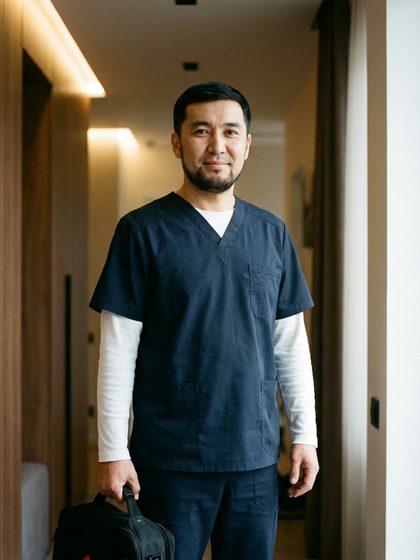
- A procedure nurse experienced in giving injections, including to elderly patients and patients with limited mobility
- What the nurse brings
- Single-use syringes and needles, antiseptics, gloves, a sharps container, and emergency supplies
- How long it takes
- The injection itself takes a few minutes; including checking the prescription and observation afterward, 15–30 minutes
- Arrival time
- Around the clock; a one-time visit on average within 60 minutes, a course of treatment at a fixed agreed time
- When to call 103 immediately
- Swelling of the face and throat, choking or severe shortness of breath, a rash all over the body, a sudden drop in blood pressure, loss of consciousness after an injection
- Documents
- A doctor's prescription with the name of the drug, route, and frequency of administration, and the patient's ID
What you should know
A course of injections seems like a small thing until you have to go to a treatment room every day, sometimes twice a day. For working parents it means constantly asking for time off; for elderly people, trips through frost and ice; for mothers with babies, finding someone to watch the child. DomVrach takes this burden off your shoulders: a nurse comes at a convenient time, gives the injection, and leaves, while you go on with your day without trips, waiting lines, or worrying about a missed dose.
We often help families who care for their parents from a distance: the adult children live on Astana's Left Bank, while mom or dad lives on the Right Bank or in the suburbs. You agree on the course schedule by phone, the nurse visits your parents, and after each procedure can send you a short message confirming that the injection was given and that the patient is feeling fine. This way the course goes ahead without missed doses, even if you are away on a business trip.
When It Makes Sense to Book Injections at Home
- a doctor has prescribed a course of intramuscular or subcutaneous injections, and going to the clinic every day is hard
- an elderly relative lives alone, and their adult children cannot drive them to procedures because of work
- a patient after surgery or an injury who has difficulty getting around
- injections are needed twice a day, including early in the morning or late in the evening
- there is a baby in the family, and it is hard for the mother to leave home for a procedure
- winter ice and frost make trips dangerous for an elderly person
- you have just moved or are visiting and are not yet registered with a clinic in your district
If several points apply, call a doctor. For chest pain, difficulty breathing, signs of stroke, seizures or loss of consciousness, call 103 or 112 immediately.
Why Injections Are Best Left to a Nurse
Having relatives give injections may seem like a way to save money, but it carries real risks: the wrong injection site, nerve damage, a break in sterility, or an abscess. In elderly people with thin muscle tissue and in patients taking anticoagulants (blood thinners), technique is especially important. A nurse chooses the right site, needle length, and injection speed, and rotates injection sites.
The second important point is observation after the injection. Some drugs can cause an allergic reaction in the first few minutes. The nurse stays with the patient, monitors how they feel, and provides help immediately if needed. The nurse also watches for changes: if the patient's blood pressure is too low or new symptoms have appeared, the nurse will tell you and recommend contacting a doctor.
How an Injection Visit at Home Works
You call and give us the doctor's prescription, your address, and a convenient time. The nurse arrives, checks the drug against the prescription, verifies the expiration date and that the packaging is intact, and asks about allergies. The nurse then cleans their hands and the skin, gives the injection with a single-use syringe, and observes the patient for several minutes. If you have questions about the course or side effects, you can book an online consultation with a doctor without leaving home.
The nurse does not prescribe or change medications — only a doctor can do that. The nurse will not give a drug without a written prescription, if it is past its expiration date, or if the packaging is damaged. If swelling of the lips, difficulty breathing, a rash all over the body, or weakness with a drop in blood pressure appears after the injection, it may be anaphylaxis: the nurse will start emergency care and call 103.
How we help
Intramuscular injections
These are given into the buttock muscle or the muscles of the thigh or upper arm, depending on the drug and volume. The nurse chooses the correct quadrant to avoid damaging nerves and blood vessels and alternates sides during a course of treatment. For elderly patients and people with low body weight, the nurse selects an appropriate needle. After the injection, the site is gently pressed with an antiseptic wipe.
Subcutaneous injections
These are used, for example, to give anticoagulants, insulin, or a number of other drugs prescribed by a doctor. The nurse follows the technique of injecting into a skin fold and rotates injection sites to prevent lumps and bruising. If you want to learn to give subcutaneous injections yourself, the nurse will show you the technique and check how you are doing.
Intravenous push injections
Some drugs are injected slowly into a vein without an IV drip. This takes experience: the nurse must find a suitable vein, keep to the correct injection speed, and watch for reactions. In elderly patients, veins are often fragile, so the nurse works especially carefully. If no vein is accessible, the nurse will inform the doctor and discuss an alternative.
A scheduled course of treatment
For a course of 5–10 or more injections, it is convenient to set a fixed visit time. The nurse comes at the same time each day, which matters for keeping the drug's effect steady. If the patient lives alone, we can agree on who will open the door and send relatives a confirmation after each visit. A procedure can be rescheduled if you let the dispatcher know in advance.
Myths and facts
MythAny family member can give a relative injections
FactSubcutaneous injections can be learned under a nurse's guidance. Intramuscular and especially intravenous injections are risky without proper skills: nerve damage, an abscess, or hitting a blood vessel. It is better to leave them to a professional, especially for elderly patients.
MythIf an injection hurts, it means the medicine is working
FactHow much an injection hurts depends on the drug, the volume, the injection technique, and the condition of the muscles, not on how effective it is. Correct technique and slow injection noticeably reduce discomfort.
MythInjections are always more effective than pills
FactInjections are needed when a drug is not available in tablet form, a fast effect is required, or the patient cannot take medication by mouth. In many cases, pills work just as well. The doctor chooses the form of the medication.
How to call a doctor
- Call or message usWe answer 24/7: we'll ask about symptoms, age and chronic conditions and tell you which doctor you need. If an ambulance is needed, we'll say so straight away.
- Give us the addressHome, apartment, hotel or office. We'll tell you when the doctor will arrive — in the city, about 60 minutes on average.
- The doctor arrivesExamination, blood pressure, oxygen saturation, temperature and, if needed, an ECG, rapid tests and blood draw. The doctor explains the diagnosis and prescribes treatment.
- You get helpAn injection or IV drip if indicated, written advice, a sick note or certificate after the examination, and a follow-up call.
Prices in Astana
| Intramuscular or intravenous injection | 5 000 ₸ |
| IV drip at home (medication extra) | 15 000 ₸ |
| Vitamin IV drip | 20 000 ₸ |
| Phone advice | free |
The final cost is agreed before treatment starts. Prices are in tenge and do not constitute a public offer.
Where to get help
DomVrach in Astana: a doctor comes to your home in about 60 minutes on average (all city districts and nearby settlements). Two addresses for appointments and procedures — 37 Kenesary St., office 41, Astana and 112 Turan Ave., Astana. We also visit tourists in hotels and companies in their offices.
Confidential and private
in Astana the doctor comes at a convenient time, including to your hotel or office. Treatment documents are given only to the patient or their legal representative.
Questions and answers
Do I need to buy the medication for the injection myself?
As a rule, you buy the drug prescribed by the doctor at a pharmacy in advance. The nurse brings single-use syringes, needles, antiseptics, and everything else needed for a safe procedure. Make sure that the name and strength on the package match the prescription.
Can I book an injection late in the evening or at night?
Yes, DomVrach works around the clock. This is convenient if injections are prescribed twice a day or if you get home from work late. It is best to arrange a night visit in advance so the nurse arrives exactly on time and the course is not interrupted.
What should I do if a lump forms at the injection site?
A small hard area after an intramuscular injection is common and usually goes away on its own. If the site becomes red, hot, or painful, or you develop a fever, see a doctor: it may be an early abscess, which must not be treated on your own.
Can you give injections to a child?
Yes, as prescribed by a pediatrician. The nurse takes the child's age and weight into account and chooses the needle and injection site accordingly. A calm approach is especially important for children: the nurse will explain what is going to happen, and a parent can hold the child during the procedure.
What if an elderly parent lives alone and cannot open the door?
Agree with the dispatcher in advance on who will meet the nurse: a neighbor, a social worker, or a relative. You can leave a key with a trusted person. The nurse does not enter the apartment unless the patient or an agreed-upon person is present — this is a matter of safety for everyone.
Do you give injections in the suburbs of Astana?
Yes, we travel to Kosshy, Koyandy, and other nearby suburbs. For a course of treatment, it is best to agree on a fixed visit time to allow for travel. In severe frost and snowstorms, travel time increases — the dispatcher will always let you know.
Where do doctors visit in Astana and where are the branches?
Home visits cover all city districts and nearby settlements, 24/7. Appointments at two branches: 37 Kenesary St., office 41, Astana and 112 Turan Ave., Astana. Phone in Astana: +7 (700) 309-38-25.
Sources and methodology
This page was prepared by the DomVrach medical editorial team based on:
- Clinical diagnosis and treatment protocols of the Ministry of Health of the Republic of Kazakhstan
- Code of the Republic of Kazakhstan “On Public Health and the Healthcare System”
- International Classification of Diseases ICD-10, World Health Organization
- WHO recommendations on primary health care
- NICE (UK) guidelines on managing acute and chronic conditions in primary care
This information is for reference only and does not replace a consultation with a specialist. Editorial policy