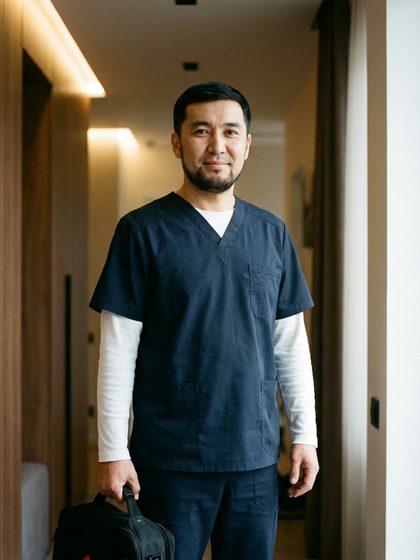
Reviewed bySerik Nurgaliev, MDAddiction physician, house calls, Makes house calls · updated 8 Nov 2026
Key facts
- Who comes
- A nurse experienced in giving injections; a doctor if an examination or prescription is needed
- What they bring
- Single-use syringes and needles, antiseptic, gloves, plasters, a sharps container and an anaphylaxis kit
- How long it takes
- Usually 15–30 minutes, including observation after the injection; longer for a first dose
- Arrival time
- About 60 minutes on average; injections in a treatment course are given at an agreed time every day
- Call 103 immediately
- Swelling of the face and lips, difficulty breathing, a sudden drop in blood pressure, or a full-body rash after an injection
- Documents
- A doctor's prescription or discharge summary, the medication in its original packaging, and an ID card
What you should know
In the notes of a doctor who drives around Almaty every day, injections at home are one of the “quietest” services. A course of medication after discharge for an elderly person in Auezov district who struggles to get down from the fifth floor of a building with no elevator. Post-surgery injections for a man who is not allowed to drive. A course for a mother with a newborn she has no one to leave with. Every time, the goal is the same: to give the injection correctly and safely, without unnecessary trips through traffic.
A DomVrach nurse arrives with single-use syringes, antiseptic, gloves and an emergency kit. Before the injection, she checks the doctor's prescription, the name of the medication, its expiry date and whether the packaging is intact, and asks whether you have ever had an allergic reaction. After the injection, she stays with you for a few minutes to make sure there is no adverse reaction. If the medication is being given for the first time, she stays longer to observe you.
When It Makes Sense to Call a Nurse for Injections
- your doctor has prescribed a course of injections, but traveling to a treatment room every day is hard
- an elderly or bedridden relative needs regular intramuscular injections
- after surgery or an injury you are not allowed to drive or sit in a car for long
- you need subcutaneous injections but lack the skill or confidence to give them yourself
- your child has been prescribed injections and you want a medical professional to give them
- the medication must be given at strict times that do not fit the clinic's schedule
- you need an intravenous bolus injection, which must be given by a healthcare professional
If several points apply, call a doctor. For chest pain, difficulty breathing, signs of stroke, seizures or loss of consciousness, call 103 or 112 immediately.
Why It Matters That Injections Are Given Correctly
An injection may look like a simple procedure, but mistakes happen more often than people think. Choosing the wrong site for an intramuscular injection can damage a nerve or blood vessel, a breach of sterility can lead to an abscess, and injecting too quickly can cause pain and a sharp reaction. Some medications must not be mixed in the same syringe, and others need to be stored at a specific temperature. A nurse knows all of these subtleties.
In Almaty, storage matters especially in summer: in the heat, medications that should be kept in the refrigerator spoil in a car or on a windowsill. The nurse checks how the medication has been stored and what the solution looks like before giving the injection. We give antibiotic injections only when prescribed by a doctor. Injecting them “just in case” for a cold is not acceptable, as it goes against WHO recommendations and the clinical protocols of the Ministry of Health of Kazakhstan.
How a Nurse Visit for Injections Works
You call us with the name of the medication, how it is to be given and the number of injections in the course, and tell us about the doctor's prescription. The nurse arrives at the agreed time, washes her hands, puts on gloves, and checks the medication and prescription. She then cleans the skin, gives the injection, applies a plaster and disposes of the syringe in a special container. After the injection, she observes how you feel for 5–15 minutes. If you do not have a prescription, a doctor can hold an online consultation or come to examine you.
The nurse will not start injections without a doctor's prescription and will not give any medication that raises doubts: one without packaging, past its expiry date or with a change in color. At the first sign of an allergic reaction, such as swelling, rash, difficulty breathing or weakness, she provides emergency care and calls 103. If you notice these symptoms after an injection you gave yourself, call 103 right away as well.
How we help
Intramuscular Injections
This is the most common type of injection given at home. The nurse chooses a safe site, usually the upper outer part of the buttock or the outer thigh, cleans the skin and injects the medication at the right speed. During a course, injection sites are rotated to prevent hard lumps from forming. If a painful lump or redness appears after the injections, the nurse will assess it and, if necessary, inform the doctor.
Subcutaneous Injections
Some blood thinners, hormonal medications and vaccines are given subcutaneously as prescribed. The nurse injects into the abdomen, upper arm or thigh, following the correct technique and rotating sites. If you will need to give these injections yourself, the nurse will show you the technique, answer your questions and check how you are managing.
Intravenous Bolus Injections
Some medications are injected slowly into a vein with a syringe. Only a healthcare professional should do this, because it is important to enter the vein correctly, maintain the right speed and watch for reactions. The nurse monitors your blood pressure and how you feel during the injection. These injections are given strictly as prescribed by a doctor after an examination, and when a medication is given for the first time, the nurse stays with you longer.
A Scheduled Course of Injections
If a course has been prescribed, we agree on convenient visit times: in the morning before work, in the evening or on weekends. The nurse keeps a record of each injection and monitors the injection sites and how you feel. If side effects appear, only the doctor can adjust the course. Do not stop or change the medication on your own; it is better to report the side effects right away.
Myths and facts
MythInjections always work better than pills
FactMany medications are equally effective as tablets and as injections. Injections are prescribed when a drug cannot be taken by mouth, needs to act quickly, or exists only in injectable form. That decision is up to the doctor.
MythAnyone who has seen it done can give an injection
FactA mistake in technique or sterility can lead to an abscess, nerve damage or an allergic reaction with no one around to help. A nurse knows the anatomy, which medications are compatible and what to do in case of anaphylaxis.
MythIf an injection hurts, the medication is working well
FactSevere pain usually means the medication was injected too quickly, the site was poorly chosen or the solution is irritating, not that it is effective. Persistent pain, redness or a hard lump should be reported to the nurse or doctor.
How to call a doctor
- Call or message usWe answer 24/7: we'll ask about symptoms, age and chronic conditions and tell you which doctor you need. If an ambulance is needed, we'll say so straight away.
- Give us the addressHome, apartment, hotel or office. We'll tell you when the doctor will arrive — in the city, about 60 minutes on average.
- The doctor arrivesExamination, blood pressure, oxygen saturation, temperature and, if needed, an ECG, rapid tests and blood draw. The doctor explains the diagnosis and prescribes treatment.
- You get helpAn injection or IV drip if indicated, written advice, a sick note or certificate after the examination, and a follow-up call.
Prices in Almaty
| Intramuscular or intravenous injection | 5 000 ₸ |
| IV drip at home (medication extra) | 15 000 ₸ |
| Vitamin IV drip | 20 000 ₸ |
| Phone advice | free |
The final cost is agreed before treatment starts. Prices are in tenge and do not constitute a public offer.
Where to get help
In almaty you can get help at home, at one of our two addresses (1B Issykskaya St., Almaty, 71 Rayymbeka Ave., office 12, Almaty) or online if you need advice rather than an examination. We answer 24/7 and will suggest the best option.
Confidential and private
Information about your health is protected by medical confidentiality under the Code of the Republic of Kazakhstan “On Public Health and the Healthcare System”. We don't share it with employers, schools or third parties without your consent, except where expressly required by law.
Questions and answers
Can I get an injection without a doctor's prescription?
No. A DomVrach nurse gives injections only as prescribed by a doctor, whether in a discharge summary, a prescription or a note in your medical record. If you have no prescription, you need an examination first: a doctor will visit you at home or hold an online consultation and decide whether the medication is needed and in what form.
Do I buy the medication myself, or will the nurse bring it?
Usually you buy the prescribed medication yourself at a pharmacy and store it according to the instructions. The nurse brings syringes, antiseptics and everything needed for a safe procedure. If you are unsure what size syringe is needed or how to store the medication, ask the dispatcher when you call.
Can I call a nurse to give injections to my child?
Yes, nurses give injections to children as prescribed by a pediatrician. The nurse will choose the injection site based on the child's age and weight and try to make the procedure quick and calm. A parent must be present. If your child develops a rash, swelling or lethargy after the injection, call 103 immediately.
How much does a course of injections at home cost?
The price depends on the type of injection, the number of visits and the time of day. A course usually comes with a lower price per visit. The dispatcher will give you the exact cost in advance once you tell us the medication, how it is given and the schedule.
Will a nurse come to Nauryzbay or Alatau district?
Yes, nurses visit all districts of the city, including Nauryzbay and Alatau districts, as well as the suburbs. At rush hour, getting to outlying neighborhoods can take longer, so for a course of injections it is best to agree on a fixed visit time in advance.
What should I do if a lump appears after an injection?
A small hard lump after an intramuscular injection often goes away on its own within a few days. If the lump grows, turns red, feels hot and painful, or you develop a fever, it may be inflammation and you need to see a doctor. Do not apply heat to it or try to open it yourself.
Where do doctors visit in Almaty and where are the branches?
Home visits cover all city districts and nearby settlements, 24/7. Appointments at two branches: 1B Issykskaya St., Almaty and 71 Rayymbeka Ave., office 12, Almaty. Phone in Almaty: +7 (700) 309-38-25.
Sources and methodology
This page was prepared by the DomVrach medical editorial team based on:
- Clinical diagnosis and treatment protocols of the Ministry of Health of the Republic of Kazakhstan
- Code of the Republic of Kazakhstan “On Public Health and the Healthcare System”
- International Classification of Diseases ICD-10, World Health Organization
- WHO recommendations on primary health care
- NICE (UK) guidelines on managing acute and chronic conditions in primary care
This information is for reference only and does not replace a consultation with a specialist. Editorial policy