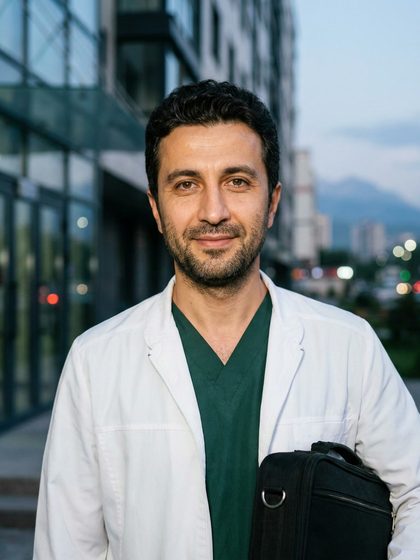
Reviewed byMurat Akhmetov, MDSurgeon, house calls, Makes house calls · updated 8 Nov 2026
Key facts
- Who comes
- An orthopedic trauma surgeon experienced in the outpatient management of bruises, sprains, fractures, and the after-effects of injuries
- What they bring
- Elastic bandages, supportive dressings and braces when indicated, dressing supplies, and a blood pressure monitor
- How long it takes
- 30–60 minutes: questions, an examination, immobilization, and recommendations on activity and pain relief
- Arrival time
- About 60 minutes on average within Astana; in icy conditions and blizzards, the time depends on the road
- When to call 103 right away
- An obviously deformed limb, an open fracture, heavy bleeding, a head injury with vomiting or loss of consciousness, a neck or back injury
- Documents
- Your ID card, X-rays and reports if you have them, discharge summaries after surgery, and a list of medications
What you should know
In Astana in winter, falls on ice are one of the most common causes of injury. An elderly mother slips outside her building, a child lands badly at the ice rink, or you twist your ankle on the way to your car. Going to a trauma center with pain and swelling is inconvenient and sometimes frightening. An orthopedic trauma doctor home visit means the doctor comes to you, examines the injury, checks mobility and sensation, decides whether there are signs of a fracture and whether an X-ray is needed, and prescribes treatment and a daily routine right away.
DomVrach sends an orthopedic trauma doctor to any district of Astana, on both the left and right banks: Yesil, Nura, Almaty, Saryarka, and Baikonur districts, and, by arrangement, Kosshy and Koyandy. Trauma doctors are especially often called for elderly parents after a fall: even without a fracture, such an injury reduces mobility and needs monitoring. If you are far away, leave your phone number: with the patient's consent, the doctor will tell you about the examination results and the recovery plan.
When to Call an Orthopedic Trauma Doctor to Your Home
- a bruise or sprain after a fall on ice, with swelling and pain on movement
- an older person has fallen and can move but complains of pain in the hip or arm
- joint pain and swelling that make it hard to walk around the apartment
- you need a follow-up after a cast has been removed or after joint surgery
- chronic knee or shoulder pain has flared up and makes it hard to leave home
- a sports injury in a teenager without an obviously deformed limb
- you need a supportive bandage or a brace and advice on how much load to put on the limb
If several points apply, call a doctor. For chest pain, difficulty breathing, signs of stroke, seizures or loss of consciousness, call 103 or 112 immediately.
Why Injuries Happen So Often in Astana
The long winter, frosts down to −35 °C (−31 °F), ice, and wind, which in Astana is especially strong in the open spaces of the left bank, make falls an everyday occurrence. Courtyards, building entrance steps, shopping mall parking lots, and pedestrian crossings can all become slippery overnight after a thaw. Wrists, ankles, knees, and hips are injured most often, and in older people, the neck of the femur (hip fracture).
In older people, bones become more fragile because of osteoporosis, so even a simple fall from standing height can lead to a fracture. Children and teenagers get injured at ice rinks, on sledding hills, and in sports clubs. For working adults, an injury means lost days at work, and for relatives who live apart from their parents, it means worry. A home visit by an orthopedic trauma doctor helps assess the situation quickly.
What Happens During an Orthopedic Trauma Doctor Home Visit
The doctor asks how the injury happened, where it hurts, and whether the patient can put weight on the leg or move the arm. The doctor examines the injured area and assesses swelling, deformity, mobility, sensation, and the pulse below the injury. If there are no signs of a fracture, the doctor applies a supportive bandage and chooses pain relief. If a fracture is suspected, the doctor refers the patient for an X-ray. The images can then be shown to the doctor online.
An X-ray or a CT scan cannot be done at home, a cast cannot be properly applied after the bones have been reset, and surgery cannot be performed. If there is an obvious deformity, an open fracture, heavy bleeding, a head injury with vomiting or loss of consciousness, a neck or back injury, or a suspected hip fracture in an older person, do not move the injured person and call 103 or 112.
How we help
Bruises and sprains
For bruises and sprained ligaments, the doctor assesses how severe the injury is and prescribes treatment: rest for the injured area, cold during the first 24 hours, keeping the limb elevated, a supportive bandage, and pain relief drug groups when indicated. The doctor explains when you can start putting weight on the limb again and which signs call for another examination.
Suspected fracture
Without an X-ray, a fracture can only be suspected based on clinical signs. The doctor performs an examination, temporarily immobilizes the limb, and explains where and how quickly to get an X-ray. If a fracture is confirmed, the doctor will advise on the next steps. In serious cases, the doctor will call 103 personally and help arrange transport.
Falls in older people
After an older person falls, it is important to assess not only the injury but also its cause: dizziness, weakness, blood pressure, or medication side effects. The doctor checks mobility and the risk of another fall and gives advice on safety at home. If needed, DomVrach will arrange a visit from a GP or a neurologist to find out the cause.
Follow-up after injuries and surgery
After a cast is removed or after joint replacement surgery, follow-up examinations and work on restoring movement are needed. The doctor assesses healing and range of motion and recommends exercises and a timeline for returning to physical activity. This reduces the risk of complications and helps patients get back to work, sports, and their usual routine sooner.
Myths and facts
MythIf you can move your arm, it isn't broken
FactBeing able to move does not rule out a fracture: with some fractures, the fingers and joint still move, although it hurts. Only an examination and an X-ray can accurately assess the injury, especially in older people and children.
MythA sprain should be warmed up right away
FactDuring the first 24 hours after an injury, cold, rest, and keeping the limb elevated are usually recommended. Applying heat during the acute phase can increase swelling. It is best to check the approach with a doctor.
MythAfter a fall, an older person just needs to rest in bed
FactEven without obvious injuries, a fall may hide a fracture or a head injury, or it may be a sign of another illness. A doctor's examination helps find the cause and reduce the risk of further falls.
How to call a doctor
- Call or message usWe answer 24/7: we'll ask about symptoms, age and chronic conditions and tell you which doctor you need. If an ambulance is needed, we'll say so straight away.
- Give us the addressHome, apartment, hotel or office. We'll tell you when the doctor will arrive — in the city, about 60 minutes on average.
- The doctor arrivesExamination, blood pressure, oxygen saturation, temperature and, if needed, an ECG, rapid tests and blood draw. The doctor explains the diagnosis and prescribes treatment.
- You get helpAn injection or IV drip if indicated, written advice, a sick note or certificate after the examination, and a follow-up call.
Prices in Astana
| Specialist home visit | 25 000 ₸ |
| ECG with interpretation during the visit | 6 000 ₸ |
| Follow-up visit | 15 000 ₸ |
| Phone advice | free |
The final cost is agreed before treatment starts. Prices are in tenge and do not constitute a public offer.
Where to get help
DomVrach in Astana: a doctor comes to your home in about 60 minutes on average (all city districts and nearby settlements). Two addresses for appointments and procedures — 37 Kenesary St., office 41, Astana and 112 Turan Ave., Astana. We also visit tourists in hotels and companies in their offices.
Confidential and private
in Astana the doctor comes at a convenient time, including to your hotel or office. Treatment documents are given only to the patient or their legal representative.
Questions and answers
Can a trauma doctor detect a fracture without an X-ray?
The doctor can suspect a fracture based on clinical signs: deformity, sharp pain when bearing weight, swelling, and loss of function. But only an X-ray can definitively confirm or rule out a fracture. The doctor will tell you whether an X-ray is needed and how urgently.
What should I do right after an older person falls?
Do not lift them up abruptly. Ask where it hurts and whether they can move their arms and legs. If there is severe hip pain, they cannot stand up, or there is a head injury with vomiting or loss of consciousness, call 103. If the person can move and the pain is moderate, call an orthopedic trauma doctor.
Does the trauma doctor apply casts at home?
A full plaster or fiberglass cast is usually applied after an X-ray at a trauma center. At home, the doctor can temporarily immobilize the limb with a splint, a bandage, or a brace and will tell you where to go for definitive immobilization.
Can I call a trauma doctor for a child?
Yes, the doctor also examines children. Children's bones differ from adults', and some fractures are hard to detect in children. If there is a deformity, severe pain, or the child refuses to move an arm or leg, the doctor will refer them for an X-ray, and in the case of a serious injury, will call 103.
How long does it take to recover from a sprain?
It depends on how severe the injury is and the patient's age: anywhere from a few days to several weeks. The doctor will assess the injury and choose an appropriate activity level and exercises. If the pain and swelling do not go down, a repeat examination and possibly additional tests are needed.
Can I get a sick note after a trauma doctor's visit?
A sick note (certificate of temporary incapacity for work) is issued only after an in-person examination and in the manner established by the laws of the Republic of Kazakhstan. The doctor will assess whether there are grounds for one. We do not issue documents without an examination, but the doctor will explain the steps needed to obtain one.
Where do doctors visit in Astana and where are the branches?
Home visits cover all city districts and nearby settlements, 24/7. Appointments at two branches: 37 Kenesary St., office 41, Astana and 112 Turan Ave., Astana. Phone in Astana: +7 (700) 309-38-25.
Sources and methodology
This page was prepared by the DomVrach medical editorial team based on:
- Clinical diagnosis and treatment protocols of the Ministry of Health of the Republic of Kazakhstan
- Code of the Republic of Kazakhstan “On Public Health and the Healthcare System”
- International Classification of Diseases ICD-10, World Health Organization
- WHO recommendations on primary health care
- NICE (UK) guidelines on managing acute and chronic conditions in primary care
This information is for reference only and does not replace a consultation with a specialist. Editorial policy