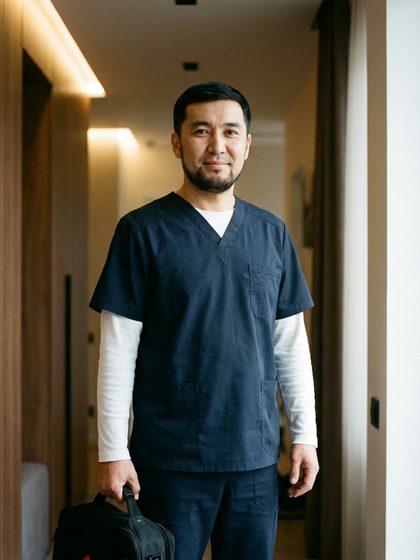
Reviewed bySerik Nurgaliev, MDAddiction physician, house calls, Makes house calls · updated 8 Nov 2026
Key facts
- Who comes
- A psychiatrist-addiction physician, together with a nurse if a longer IV drip and monitoring are needed
- What they bring
- Blood pressure monitor, pulse oximeter, glucose meter, rapid test kits, detoxification solutions, medications from the appropriate groups as indicated
- How long it takes
- Usually 1.5–3 hours; in marked withdrawal, repeat visits over several days may be needed
- Confidentiality
- No entry in a registry, documents optional; medical confidentiality under the Kazakh Code “On Public Health”
- When to call 103 right away
- Hallucinations, seizures, loss of consciousness, chest pain, slowed or shallow breathing, suspected overdose
- Outcome
- Relief of withdrawal symptoms, restored sleep, and a plan for addiction treatment and family support
What you should know
Withdrawal syndrome — what people often call “the shakes” or being “dopesick” — is how a body that has adapted to a substance reacts when that substance is stopped. The person becomes irritable, cannot sleep, swings between hot flashes and chills, has shaking hands and aches all over. It is hard not only for the patient but also for the family, who see their loved one suffering and do not know how to help. In Astana's winter, with frosts down to −35 °C and strong winds outside, getting such a person to a clinic can be especially difficult.
A home visit from an addiction physician makes it possible to start treatment where the person feels calmer and the family feels more at ease. You can book the visit while you are at work, and the doctor will go to your son's rented apartment in the Nura district or to a relative on the Right Bank. New residents and newcomers to the city do not need to be registered with a polyclinic, and business travelers do not need local residence registration. Information about treatment is protected by medical confidentiality: we do not put anyone on a registry and do not inform employers or schools and universities.
When You Need Withdrawal Treatment at Home
- after stopping use, the person has developed shaking, sweating and severe anxiety
- several nights in a row without sleep; the person is irritable and cannot settle
- muscle and joint pain, chills, nausea or diarrhea after stopping the substance
- blood pressure is swinging, the pulse is fast, and there is a feeling of not getting enough air
- the patient has decided to stop using and is asking for medical help
- previous attempts to quit on their own ended in relapse
- the family is afraid to leave the person alone during withdrawal
If several points apply, call a doctor — visits are confidential and nothing is registered. For hallucinations, seizures, chest pain, vomiting blood, loss of consciousness, suicidal thoughts or any threat to life, call 103 or 112 immediately.
Why Withdrawal Syndrome Develops
With regular use of alcohol, sleeping pills or drugs, the nervous system rewires itself: it starts to function with the constant presence of the substance “built in.” When use stops abruptly, this balance is upset, causing either overexcitation or, conversely, profound weakness. The symptoms depend on the type of substance, how long it has been used and the person's overall health. That is why treatment is always individual and begins with a thorough examination and medical history.
The risk of severe withdrawal is higher in people with a long history of use, after previous severe episodes, when several substances are combined, in older adults and in those with heart or liver disease. This is exactly why trying to manage withdrawal on your own with medicines from the cabinet or “advice from friends” is dangerous. A DomVrach addiction physician first assesses whether treatment at home is safe and will tell you honestly if hospital care is needed. We do not discuss ways of using substances or “safe doses” — only treatment.
How Withdrawal Treatment at Home Works
The doctor asks in detail which substance was used and for how long, when the last use was, and about any health conditions and allergies. They measure blood pressure, pulse, oxygen saturation and blood sugar, and assess consciousness, pupils, tremor and signs of dehydration. They then set up an IV drip with detoxification solutions, vitamins and other medications as indicated, and monitor the patient until it is finished. The next day, you can discuss how the patient is feeling online and decide whether a repeat visit is needed.
Withdrawal is not treated at home if there are hallucinations, seizures, confusion or serious heart rhythm disturbances, or if an overdose or mixed poisoning is suspected. In these cases, hospital care is essential, and if there is a threat to life, call 103 or 112 without waiting for the addiction physician. If the visiting doctor sees dangerous signs, they will arrange hospitalization themselves and hand over all the information to the ambulance crew.
How we help
Detoxification therapy
Intravenous solutions restore fluid volume and the electrolyte balance disrupted by vomiting, diarrhea and sweating. When indicated, the doctor adds B vitamins, liver-protecting medications and stomach-protecting agents. The composition and rate of the drip are determined by the results of the examination, taking into account heart and kidney function, so there is no standard set that suits everyone.
Symptom relief
To reduce anxiety, insomnia, pain and nausea, the doctor may prescribe medications from the relevant groups — sedatives, sleeping medication, pain relievers and anti-nausea drugs. All of them are prescribed only by the doctor, after assessing the risk of interactions. Taking tranquilizers on your own during withdrawal can lead to dangerously suppressed breathing, especially in combination with traces of the substance still in the body.
Monitoring in the first few days
The acute phase of withdrawal usually lasts several days, and the person's condition changes over that time. The addiction physician agrees with the family on repeat visits or online follow-up and explains which signs mean you need to call an ambulance. For relatives who cannot be there all the time — for example, if they live in the Yesil district and the patient lives in Kosshy — the doctor provides a short, clear monitoring checklist.
Further addiction treatment
Getting through withdrawal is only the first step. Once the patient is stable, the doctor discusses the options with them: outpatient follow-up, psychotherapy, a rehabilitation program and work with the family. The decision is the patient's own. We do not promise a guaranteed cure, but we help choose a path that will genuinely support the decision not to return to using.
Myths and facts
MythWithdrawal can just be toughed out; it is not dangerous
FactWith some types of addiction, severe withdrawal can be accompanied by seizures, delirium and heart rhythm disturbances. It is hard to assess the risk yourself, so stopping use is best done under a doctor's supervision — and in a hospital if dangerous signs appear.
MythAn addiction physician is obliged to report you to the police
FactMedical confidentiality is protected by the Kazakh Code “On Public Health and the Healthcare System.” Paid confidential care does not require registration, and information is disclosed only in cases expressly provided for by law. The doctor's goal is treatment, not punishment.
MythOnce withdrawal is over, you are cured
FactWithdrawal passes within days, but cravings and habitual patterns of use last much longer. Without further treatment and support, the risk of relapse is high, so it is important to continue working with an addiction physician and a psychotherapist.
How to call a doctor
- Call or message usWe answer 24/7: we'll ask about symptoms, age and chronic conditions and tell you which doctor you need. If an ambulance is needed, we'll say so straight away.
- Give us the addressHome, apartment, hotel or office. We'll tell you when the doctor will arrive — in the city, about 60 minutes on average.
- The doctor arrivesExamination, blood pressure, oxygen saturation, temperature and, if needed, an ECG, rapid tests and blood draw. The doctor explains the diagnosis and prescribes treatment.
- You get helpAn injection or IV drip if indicated, written advice, a sick note or certificate after the examination, and a follow-up call.
Prices in Astana
| Alcohol detox at home (IV drip, basic) | 25 000 ₸ |
| Addiction doctor home visit | 20 000 ₸ |
| Hangover IV drip | 20 000 ₸ |
| Repeat IV drip | 18 000 ₸ |
| Phone advice | free |
The final cost is agreed before treatment starts. Prices are in tenge and do not constitute a public offer.
Where to get help
In astana you can get help at home, at one of our two addresses (37 Kenesary St., office 41, Astana, 112 Turan Ave., Astana) or online if you need advice rather than an examination. We answer 24/7 and will suggest the best option.
Confidential and private
in Astana the doctor comes at a convenient time, including to your hotel or office. Treatment documents are given only to the patient or their legal representative.
Questions and answers
How long does withdrawal last?
It depends on the substance, how long it was used and the person's health. Acute symptoms usually last several days, while sleep and mood problems can persist longer. After the examination, the doctor will give you a time frame for your specific situation and advise you on what to do during those days.
Can withdrawal be treated without the patient's consent?
No. An adult can only be treated with their own consent; this is a requirement of Kazakh law. If your loved one refuses, the addiction physician can advise the family. If there is a threat to life — hallucinations, seizures, or aggression that puts people in danger — call 103 or 112 immediately.
Who will know about the treatment?
Only the patient, the doctor and those family members whom the patient has chosen to include in the conversation. We do not put anyone on a registry and do not share information with employers or educational institutions. You do not have to give a surname, and you can pay for the visit without any unnecessary paperwork.
What should we prepare before the addiction physician arrives?
A list of chronic conditions and medications, and information about which substance was used and when it was last taken. If you have any medicine packaging, keep it for the doctor. Prepare a comfortable place where the patient can lie down during the IV drip.
Is home treatment suitable for teenagers?
Care for minors is provided with the involvement of parents or legal guardians. The doctor will assess the young person's condition and, if necessary, refer them to a pediatric specialist or a hospital. If there are thoughts of self-harm, call 112; children and young people can also call the 150 helpline.
Can the doctor come out to the suburbs at night?
Yes, we work around the clock, including in Kosshy and Koyandy. At night and in a snowstorm, the drive may take longer, and the operator will warn you about this. If waiting is dangerous — the person's condition is deteriorating quickly or seizures have started — call 103 without waiting for the addiction physician.
Where do doctors visit in Astana and where are the branches?
Home visits cover all city districts and nearby settlements, 24/7. Appointments at two branches: 37 Kenesary St., office 41, Astana and 112 Turan Ave., Astana. Phone in Astana: +7 (700) 309-38-25.
Sources and methodology
This page was prepared by the DomVrach medical editorial team based on:
- Clinical diagnosis and treatment protocols of the Ministry of Health of the Republic of Kazakhstan
- Code of the Republic of Kazakhstan “On Public Health and the Healthcare System”
- International Classification of Diseases ICD-10, World Health Organization
- WHO recommendations on primary health care
- NICE (UK) guidelines on managing acute and chronic conditions in primary care
This information is for reference only and does not replace a consultation with a specialist. Editorial policy