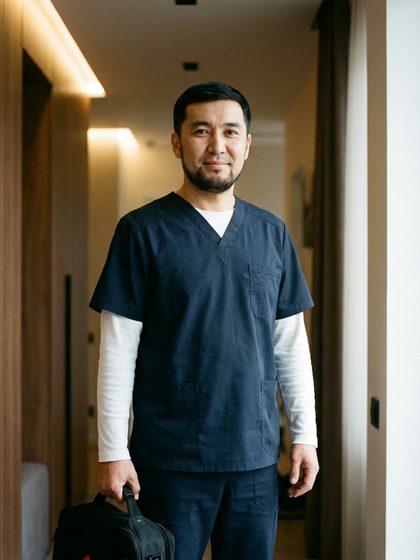
Reviewed bySerik Nurgaliev, MDAddiction physician, house calls, Makes house calls · updated 8 Nov 2026
Key facts
- Who comes
- A doctor to assess the patient and prescribe treatment, and a nurse to set up the IV drip
- What they bring
- IV lines and cannulas, saline solutions, blood pressure monitor, pulse oximeter, glucose meter, emergency kit
- How long it takes
- Usually 1–2 hours, including the examination and observation; the doctor decides on the volume
- Arrival time
- About 60 minutes on average; on summer weekends, the drive from the foothills may take longer
- Call 103 immediately
- Blood in vomit or stool, severe abdominal pain, confusion, or dehydration in an infant
- Documents
- ID card, a list of your medications, and the packaging of anything you have already taken
What you should know
In the notes of a doctor who drives around Almaty every day, summer calls about vomiting and diarrhea come in waves. Heat above 35 °C (95 °F), shashlik at a picnic in the foothills, a salad that sat in the sun, water from a questionable spring on the way down from the mountains, and by nightfall the person is lying in bed completely drained. In winter, the picture is different: viral stomach bugs that spread through the whole family in a couple of days. In both cases, the main danger is fluid loss.
At DomVrach, an IV drip is not the first step but a decision made after an examination. The doctor assesses how much fluid has been lost by checking for a dry mouth, how often the person urinates, blood pressure, pulse and skin condition. They rule out signs of surgical conditions and severe infection. If the person can drink in small sips, treatment starts with oral rehydration solutions. If they cannot, or the losses are large, the nurse sets up a drip and stays until it is finished.
When You Need a Doctor and an IV Drip for Food Poisoning
- repeated vomiting, and the person cannot keep down even a sip of water
- frequent watery stools for more than a day, with increasing weakness and dizziness
- urinating less often, dark urine and a dry mouth
- dizziness on standing and a racing heartbeat after vomiting or diarrhea
- overheating in hot weather: weakness, nausea, headache, little sweat and urine
- an elderly person or a patient with diabetes who is vomiting and quickly getting weaker
- several family members have a stomach bug and everyone needs to be assessed at once
If several points apply, call a doctor. For chest pain, difficulty breathing, signs of stroke, seizures or loss of consciousness, call 103 or 112 immediately.
Why Food Poisoning Leads to Dehydration
With vomiting and diarrhea, the body loses not only water but also salts: sodium, potassium and chloride. If they are not replaced, the blood thickens, blood pressure drops, and the kidneys and heart start to struggle. Dehydration develops fastest in children, older adults, and people taking diuretics or blood pressure medications. The causes include foodborne infections, viral gastroenteritis and, less often, poisoning with chemicals.
In Almaty in summer, the heat adds to the problem. Long walks, working outdoors and trips to Medeu or the Kaskelen Gorge without enough water lead to overheating, and even mild food poisoning is much harder to cope with on top of that. The WHO recommends oral rehydration solutions as the first choice for dehydration; an IV drip is needed when the person cannot drink or the losses are too large.
How an IV Drip for Food Poisoning Works at Home
You call us and describe how many times the person has vomited and had diarrhea, and whether there is fever, blood or abdominal pain. The dispatcher assesses any warning signs and, if necessary, directs you to 103. The doctor arrives, examines the abdomen, measures blood pressure, pulse, oxygen saturation and blood sugar, and assesses the degree of dehydration. If a drip is needed, the nurse sets up the line and monitors the infusion. Afterward, the doctor explains what and how much to drink and eat. A follow-up check can be done online.
Treatment at home is not appropriate if there is blood in the vomit or stool, severe constant abdominal pain, high fever with chills, confusion, seizures, or almost no urine for more than 12 hours. These require hospital care or a call to 103. A dehydrated infant, or a child who will not drink and is lethargic, needs urgent help. If you suspect poisoning from mushrooms, chemicals or carbon monoxide, call 103 immediately.
How we help
Assessing the Degree of Dehydration
The doctor checks for dry mucous membranes, skin turgor, pulse rate, blood pressure lying down and sitting up, urine output and level of consciousness. In children, they also look for tears, check the fontanelle in infants and assess how active the child is. Based on these signs, the doctor determines the degree of dehydration and chooses an approach: drinking rehydration solutions, an IV drip at home, or hospital admission. The decision follows WHO recommendations and the clinical protocols of the Ministry of Health of Kazakhstan.
Oral Rehydration
For mild to moderate dehydration, the doctor shows you how to drink oral rehydration solutions: often and in small sips, or a teaspoon at a time for children. This is just as effective as an IV drip, as long as the person can keep the fluid down. The doctor explains how much to drink over the next few hours and how to tell that the condition is improving.
Intravenous Rehydration at Home
If the person cannot keep fluids down or the losses are large, the nurse sets up a drip with saline solutions as prescribed by the doctor. The volume and rate are calculated based on weight, age, and heart and kidney function. The nurse monitors blood pressure, pulse and how the patient feels. After the procedure, the doctor assesses whether the patient can switch to drinking.
Recommendations After the Drip
The doctor explains how to keep drinking, what you can eat in the first few days and when to return to your normal diet. Antibiotics for stomach infections are prescribed only when indicated, not to everyone. Anti-diarrhea medications should be used only on a doctor's advice. If symptoms return or warning signs appear, you need a follow-up examination or a call to 103.
Myths and facts
MythWith food poisoning, you should start antibiotics right away
FactMost stomach infections are caused by viruses or clear up without antibiotics. Taking antibiotics unnecessarily disrupts the gut flora and contributes to bacterial resistance. Only a doctor should prescribe them, and only when indicated.
MythIf vomiting keeps you from drinking, it is better not to drink at all
FactSmall, frequent sips are usually kept down better than a big gulp. If even a teaspoon will not stay down, you need a doctor: you may need an IV drip or hospital admission, but you should not stop taking fluids.
MythAn IV drip instantly cures food poisoning
FactA drip replaces lost fluids and salts but does not remove the cause of the poisoning. The body fights off the infection itself, and treatment supports it. Drinking enough, eating gentle food and watching for warning signs all matter.
How to call a doctor
- Call or message usWe answer 24/7: we'll ask about symptoms, age and chronic conditions and tell you which doctor you need. If an ambulance is needed, we'll say so straight away.
- Give us the addressHome, apartment, hotel or office. We'll tell you when the doctor will arrive — in the city, about 60 minutes on average.
- The doctor arrivesExamination, blood pressure, oxygen saturation, temperature and, if needed, an ECG, rapid tests and blood draw. The doctor explains the diagnosis and prescribes treatment.
- You get helpAn injection or IV drip if indicated, written advice, a sick note or certificate after the examination, and a follow-up call.
Prices in Almaty
| IV drip at home (medication extra) | 15 000 ₸ |
| Intramuscular or intravenous injection | 5 000 ₸ |
| Vitamin IV drip | 20 000 ₸ |
| Phone advice | free |
The final cost is agreed before treatment starts. Prices are in tenge and do not constitute a public offer.
Where to get help
In almaty you can get help at home, at one of our two addresses (1B Issykskaya St., Almaty, 71 Rayymbeka Ave., office 12, Almaty) or online if you need advice rather than an examination. We answer 24/7 and will suggest the best option.
Confidential and private
in Almaty the doctor comes at a convenient time, including to your hotel or office. Treatment documents are given only to the patient or their legal representative.
Questions and answers
When should I call 103 for food poisoning instead of a home doctor?
Call 103 if there is blood in the vomit or stool, severe abdominal pain, confusion, seizures, no urine for more than 12 hours, or suspected poisoning from mushrooms or chemicals. Call 103 right away if an infant has vomiting and diarrhea, or if a child is lethargic and will not drink.
Can a child have an IV drip at home for a stomach infection?
In children, the doctor tries oral rehydration first. An IV drip for a child at home is possible in some cases, at the doctor's discretion. Children with marked dehydration, lethargy or refusal to drink are admitted to the hospital, where it is safer to monitor their condition.
How long does an IV drip for dehydration take?
Usually 1–2 hours, sometimes longer. The volume and rate depend on the degree of dehydration, the patient's age, and heart and kidney function. A DomVrach nurse stays with you the whole time. After the procedure, the doctor assesses whether another drip is needed or whether drinking is enough.
What can I eat after food poisoning?
Once the vomiting has stopped, you can gradually return to ordinary light food: porridge, boiled rice, bananas, crackers and low-fat soup. There is no need to fast for long. Avoid fatty and spicy food, alcohol and sugary fizzy drinks for a few days, and keep drinking fluids.
Will a doctor come if the poisoning happened in the suburbs or at a country house?
Yes, doctors visit the suburbs, including Talgar, Kaskelen, Boralday and others. Arrival time may be longer than average, especially on summer weekends. While you wait, give the person small sips of fluid. If their condition is serious, call 103 or 112 without waiting for the doctor.
Can I call one doctor for the whole family with a stomach bug?
Yes. The doctor will examine everyone who is sick in a single visit, assess each person's degree of dehydration and give recommendations. When you call, tell us how many people are ill and their ages, especially if there are children or older adults, so the dispatcher can send a doctor with enough solutions.
Where do doctors visit in Almaty and where are the branches?
Home visits cover all city districts and nearby settlements, 24/7. Appointments at two branches: 1B Issykskaya St., Almaty and 71 Rayymbeka Ave., office 12, Almaty. Phone in Almaty: +7 (700) 309-38-25.
Sources and methodology
This page was prepared by the DomVrach medical editorial team based on:
- Clinical diagnosis and treatment protocols of the Ministry of Health of the Republic of Kazakhstan
- Code of the Republic of Kazakhstan “On Public Health and the Healthcare System”
- International Classification of Diseases ICD-10, World Health Organization
- WHO recommendations on primary health care
- NICE (UK) guidelines on managing acute and chronic conditions in primary care
This information is for reference only and does not replace a consultation with a specialist. Editorial policy