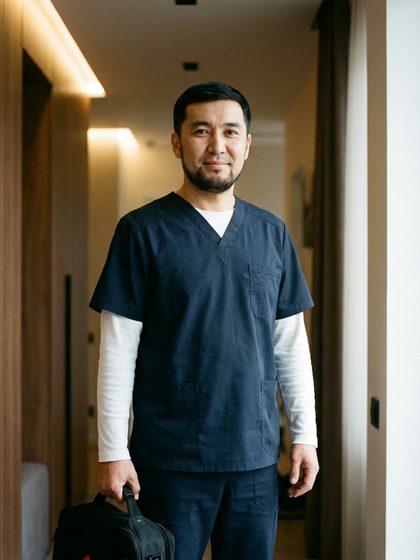
Reviewed bySerik Nurgaliev, MDAddiction physician, house calls, Makes house calls · updated 8 Nov 2026
Key facts
- Who comes
- An addiction physician; if an IV drip and longer monitoring are needed, together with a nurse
- What they bring
- A blood pressure monitor, glucose meter, pulse oximeter, infusion solutions and IV sets, and medications as clinically indicated
- How long it takes
- The exam and initial treatment usually take 1.5–3 hours; a follow-up visit or online check-in is often needed
- Confidentiality
- No surname required and no entry in the state dispensary registry; medical confidentiality under the Code of the Republic of Kazakhstan “On Public Health and the Healthcare System”
- When to call 103 right away
- Seizures, hallucinations, confusion, chest pain, loss of consciousness, suspected overdose
- Outcome
- Fewer withdrawal symptoms, an assessment of the risk of complications and a treatment plan for the next few days
What you should know
Withdrawal is a common reason for night-time calls in Almaty. A person decides to “quit” on their own and stops using, and by the second day they cannot lie still: their hands shake, the pillow is soaked with sweat, their heart rate is around 120 and they feel fear for no reason. In winter, when smog hangs over the city and people hardly go outside, these states are especially hard to bear. Relatives get scared and do not know whether to call an ambulance or wait for it to “pass on its own.”
Withdrawal syndrome is not a weakness of character; it is the reaction of a body that has become used to working in the presence of a substance. It can be mild, or it can be complicated by seizures, delirium and serious heart rhythm and blood pressure problems. The job of the addiction physician on a home visit is to understand how dangerous the condition is, ease the symptoms and, if needed, refer the person to hospital in time. We do not discuss “methods” or “doses” — only medical care and safety.
When You Need Withdrawal Treatment at Home
- after stopping use, shaking, sweating and chills have appeared
- severe anxiety, irritability and inability to fall asleep
- a racing heart, blood pressure swings, nausea and vomiting without blood
- muscle and joint aches, restlessness, the person “can’t find a place for themselves”
- the person wants to stop using but is afraid of severe withdrawal
- withdrawal was severe in the past, and the family is worried
- you need help on a confidential basis, without going to the state addiction dispensary
If several points apply, call a doctor — visits are confidential and nothing is registered. For hallucinations, seizures, chest pain, vomiting blood, loss of consciousness, suicidal thoughts or any threat to life, call 103 or 112 immediately.
Why Withdrawal Develops and Why It Is Dangerous
With regular use of alcohol or other psychoactive substances, the brain rearranges how its neurotransmitter systems work. While the substance keeps coming in, the person “holds together,” but when the supply suddenly stops, an imbalance occurs: overexcitation of the nervous system, autonomic symptoms, anxiety and pain. How long withdrawal lasts and how severe it is depends on the substance, how long it has been used, the person’s age, other illnesses and how previous episodes went.
The most dangerous complications of alcohol withdrawal are seizures and alcohol delirium, in which hallucinations, disorientation and severe agitation appear. Withdrawal from other substances can come with serious sleep problems, depression and suicidal thoughts. Trying to ease the condition with sleeping pills, painkillers or another dose of the substance without a doctor’s supervision increases the risk of overdose. That is exactly why it is better to go through withdrawal under medical supervision.
How Withdrawal Treatment at Home Works
First, the doctor asks over the phone what was used, for how long, when the last dose was taken, and whether there have been seizures or delirium before. At home, they examine the patient, measure blood pressure, pulse, temperature, oxygen saturation and blood sugar, and assess consciousness. If indicated, an IV drip with detoxification solutions and B vitamins is given, and medications that ease withdrawal symptoms are prescribed — only at the doctor’s decision. Over the following days, you can talk online and adjust the treatment.
Withdrawal cannot always be treated at home. If seizures, hallucinations or confusion appear, if there is chest pain, if the person cannot drink or eat, or if an overdose or mixing of substances is suspected, hospital care is needed — the doctor will call 103. If there are suicidal thoughts, call 112. Treatment is given only with the consent of an adult patient; involuntary hospitalization is possible only under the procedure established by the law of the Republic of Kazakhstan.
How we help
Assessing the severity of withdrawal
The doctor finds out the history of use and of previous withdrawal episodes, and assesses tremors, sweating, pulse, blood pressure, the level of anxiety and consciousness. This determines whether the person can be treated at home. The more risk factors there are — older age, heart and liver disease, seizures in the past — the more cautious the decision and the more likely the doctor is to recommend hospital care.
Infusion therapy
An IV drip with detoxification solutions helps replace fluids and electrolytes lost through sweating and vomiting and because the person is barely eating. As indicated, B vitamins and liver-protecting medications are added. The doctor chooses the rate and volume with the heart and kidneys in mind and monitors blood pressure during the infusion.
Medication support
To reduce anxiety, insomnia, tremors and autonomic symptoms, the doctor may prescribe medications from the appropriate classes. Sedatives, sleeping pills and other psychotropic drugs are used only when prescribed by a doctor, taking into account the substance the person is withdrawing from and the risk of interactions. You must not choose them yourself: this is a common cause of dangerous conditions.
Support after the acute phase
When the acute symptoms pass, weakness, poor sleep and cravings for the substance remain. During this period, family support, regular contact with the doctor and a plan for further treatment are especially important: psychotherapy, consultations with an addiction physician and, if needed, a rehabilitation program. The doctor discusses the options with the patient calmly and without pressure.
Myths and facts
MythWithdrawal just has to be endured — it will pass on its own
FactMild withdrawal can indeed pass without treatment, but it is hard to predict in advance how it will go. Seizures and delirium develop suddenly in some patients, so it is safer when a doctor assesses the condition.
MythTo ease withdrawal, you can take a little of the substance
FactUsing again prolongs the addiction and raises the risk of overdose, especially after a break, when tolerance has dropped. Symptoms should be eased by a doctor using safe methods.
MythSleeping pills from the medicine cabinet will help you get through withdrawal
FactTaking sleeping pills and sedatives without supervision during withdrawal can depress breathing and consciousness, especially when combined with alcohol. Any such medication is prescribed only by a doctor after an examination.
How to call a doctor
- Call or message usWe answer 24/7: we'll ask about symptoms, age and chronic conditions and tell you which doctor you need. If an ambulance is needed, we'll say so straight away.
- Give us the addressHome, apartment, hotel or office. We'll tell you when the doctor will arrive — in the city, about 60 minutes on average.
- The doctor arrivesExamination, blood pressure, oxygen saturation, temperature and, if needed, an ECG, rapid tests and blood draw. The doctor explains the diagnosis and prescribes treatment.
- You get helpAn injection or IV drip if indicated, written advice, a sick note or certificate after the examination, and a follow-up call.
Prices in Almaty
| Alcohol detox at home (IV drip, basic) | 25 000 ₸ |
| Addiction doctor home visit | 20 000 ₸ |
| Hangover IV drip | 20 000 ₸ |
| Repeat IV drip | 18 000 ₸ |
| Phone advice | free |
The final cost is agreed before treatment starts. Prices are in tenge and do not constitute a public offer.
Where to get help
DomVrach in Almaty: a doctor comes to your home in about 60 minutes on average (all city districts and nearby settlements). Two addresses for appointments and procedures — 1B Issykskaya St., Almaty and 71 Rayymbeka Ave., office 12, Almaty. We also visit tourists in hotels and companies in their offices.
Confidential and private
in Almaty the doctor comes at a convenient time, including to your hotel or office. Treatment documents are given only to the patient or their legal representative.
Questions and answers
How long does withdrawal syndrome last?
It depends on the substance, how long it has been used and the person’s health. Acute symptoms of alcohol withdrawal are usually most pronounced in the first few days, but weakness and sleep problems can last longer. The doctor gives an accurate outlook after the examination.
Can drug withdrawal be treated at home?
In some cases, yes — if the condition is stable, there are no signs of overdose and the risk of complications is low. But with withdrawal from certain substances, a combination of several substances or serious other illnesses, the doctor will recommend hospital care. The decision is made only after an examination.
Will you report this to the police or my employer?
No. Care is provided confidentially, without registration with the state dispensary. Information about the patient is a medical secret under the Code of the Republic of Kazakhstan “On Public Health and the Healthcare System”; it can be disclosed only in cases expressly provided for by law.
What should I do if seizures start?
Call 103 or 112 immediately. Lay the person on their side, remove hard and sharp objects from around them, do not put anything in their mouth and do not hold them down. Note the time the seizure started and do not leave the patient alone until the ambulance crew arrives, even if the seizure has stopped.
How quickly will you arrive?
On average, in about 60 minutes anywhere in Almaty. In evening traffic, during snowfall or when traveling to Nauryzbay and Alatau districts, it may take longer. We also travel to Talgar, Kaskelen, Boralday and Otegen Batyr; the operator will give you a time estimate when you call.
Does the patient have to consent?
Yes. The DomVrach addiction physician treats an adult only with their consent. If the patient refuses, the doctor can talk with them and with the family and explain the risks. A medical team cannot take a person away by force or treat them without consent: that is possible only by court decision.
Where do doctors visit in Almaty and where are the branches?
Home visits cover all city districts and nearby settlements, 24/7. Appointments at two branches: 1B Issykskaya St., Almaty and 71 Rayymbeka Ave., office 12, Almaty. Phone in Almaty: +7 (700) 309-38-25.
Sources and methodology
This page was prepared by the DomVrach medical editorial team based on:
- Clinical diagnosis and treatment protocols of the Ministry of Health of the Republic of Kazakhstan
- Code of the Republic of Kazakhstan “On Public Health and the Healthcare System”
- International Classification of Diseases ICD-10, World Health Organization
- WHO recommendations on primary health care
- NICE (UK) guidelines on managing acute and chronic conditions in primary care
This information is for reference only and does not replace a consultation with a specialist. Editorial policy